Wellness Balancing Act

Health is being reframed from a cost line into an asset. The World Economic Forum puts the value of preventive health at up to $6 trillion in savings by 2040 — a figure that turns wellbeing from a personal virtue into a macroeconomic argument. What follows from that reframing is messier than it sounds.
Synthesis tracks this force at medium momentum and medium volatility. The volatility matters here in a way it does not for slower-moving forces. Consumer behaviour, regulatory appetite and clinical technology are all moving at once, and not in the same direction.
System strain
Ageing populations, pandemics, climate-linked illness and migration flows are converging. Costs rise, and healthcare systems built for a different demographic profile start to show their limits.
The pressure is visible at both ends of life. Care.com’s 2026 report on the sandwich generation documents the mental overload of caring for children and ageing parents simultaneously — unpaid labour absorbing strain the formal system cannot. Healthcare experts speaking to The Business Times argue for early investment in healthspan rather than late investment in treatment, making the point that learning something genuinely difficult at seventy is not a trivial ask. In the United States, federal spending on health and human services for 2026 remains unsettled, which leaves planning assumptions unusually soft.
Non-communicable diseases and obesity rates sit behind this as tracked drivers, alongside government intervention on calorie control — all currently followed qualitatively rather than as indexed figures.
Hidden hunger
Calorie intake is rising while nutritional adequacy is not. Synthesis puts the figure at 51% of people lacking essential nutrients, leaving a large share of the world simultaneously overfed and undernourished.
Part of this is what is in the food. Research into whether the nutritional value of fruit and vegetables has genuinely declined continues to attract scrutiny, and FoodNavigator has begun describing the unmapped compounds in whole foods as “nutritional dark matter” — a frontier that implicitly concedes how little current nutritional science captures. Baking Business reports a triple set of headwinds pushing the food sector toward peak calories, a turning point that would have been implausible a decade ago.
Policy is responding through price. India’s National Institute of Nutrition has issued a policy brief calling for health taxes on junk food and sugary drinks, with health experts backing a sugar tax to curb obesity. The Netherlands is planning a sugar tax on food and drink. The UK has extended its existing levy to cover milkshakes and ready-to-drink lattes. Government intervention on high fat, salt and sugar products is a tracked driver for good reason.
Pharmacology is responding faster still. Reuters reports that weight-loss pill approval is set to accelerate product overhauls across the food industry, and FoodNavigator ties GLP-1 drugs together with tariffs as twin forces driving reformulation. A supercharged fibre that mimics Ozempic has been approved for EU foods, which points toward a category of functional ingredients designed to reproduce pharmaceutical effects through the grocery aisle. New dietary guidelines reported by TIME push in a parallel direction — more protein, fewer processed foods.
The mental health crisis
Anxiety, depression and stress disorders are surging, reshaping workplaces, schools and health systems.
This is the one place in the force with a hard, fast-moving number. Google Trends search interest in mental health — an index running 0 to 100 that proxies public awareness and information-seeking — has risen through Q2/2016 to Q2/2026. Synthesis rates the uncertainty on it as medium and the rate of change as rapid, which distinguishes it from almost every other indicator in the set. The corresponding driver, Awareness of Mental Wellbeing, is up 13.7% since 2016.
The response is not uniformly healthy. Business Insider reports Americans using wellness apps to turn their bodies into dashboards and finding the experience actively stressful. Forbes charts the rise of wearable sleep technology alongside a genuinely problematic future for it. Measurement, it turns out, is not the same as wellbeing — and at the luxury end the market has moved somewhere else entirely, with psychedelic wellness retreats now a 2026 category.
Three shifts to expect
The consumer approach to wellbeing becomes a dichotomy. As mental health awareness climbs, a health-conscious consumer emerges who balances physical optimisation against emotional, spiritual and social health, guided as much by intuition as by data. The two halves do not always agree.
Rising global chronic disease increases system strain. The demographic and clinical pressures above compound rather than resolve.
AI democratises access to personalised healthcare. The evidence is already commercial. Google is launching a personalised nutrition app with a Singapore microbiome firm; Calbee and AMILI are bringing personalised nutrition to the same market; Enbiosis has revealed an AI-powered nutraceutical discovery platform. Xella Health has launched specifically to detect and treat more than 130 frequently misdiagnosed women’s health conditions, and an open-source algorithm is advancing precision menstrual health beyond fertility tracking — both addressing gaps conventional clinical pathways have left open for decades.
What to watch
Personalised Medicine and Nutrition is the fastest-moving driver in this force at +20.5% since 2017, with Consumer Health Consciousness up 3.4% since 2016. Capital is following: Procter & Gamble is acquiring the supplements brand Thorne for $3.8 billion, a signal that mainstream consumer goods now treats personalised health as core rather than adjacent.
Further out, the clinical technology is arriving. Magnetic nanorobots with infrared navigation can now deliver drugs with real-time precision tracking, and Precision Neuro continues to break ground in brain–computer interfaces. McKinsey’s Future of Wellness survey remains the standing reference for how fast consumer expectations are moving underneath all of this.
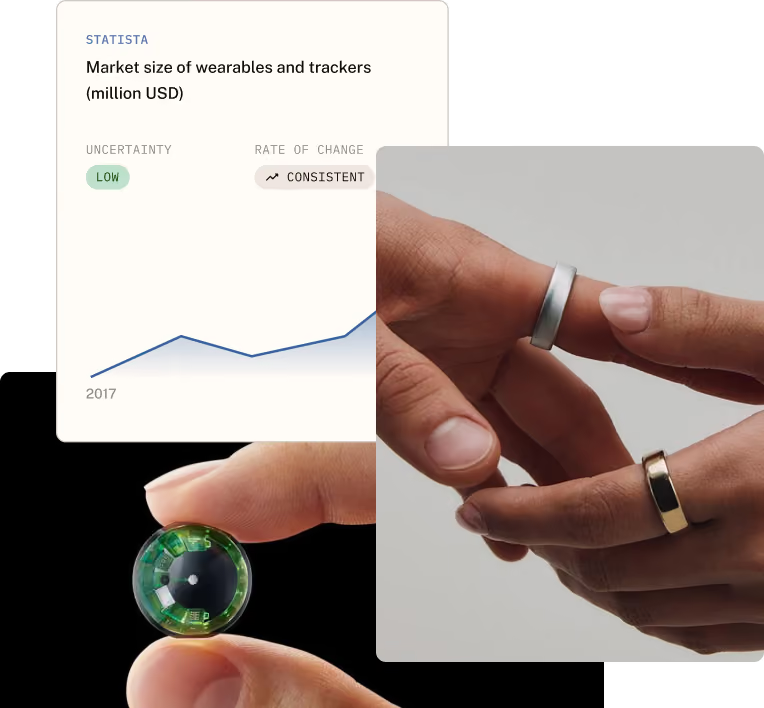
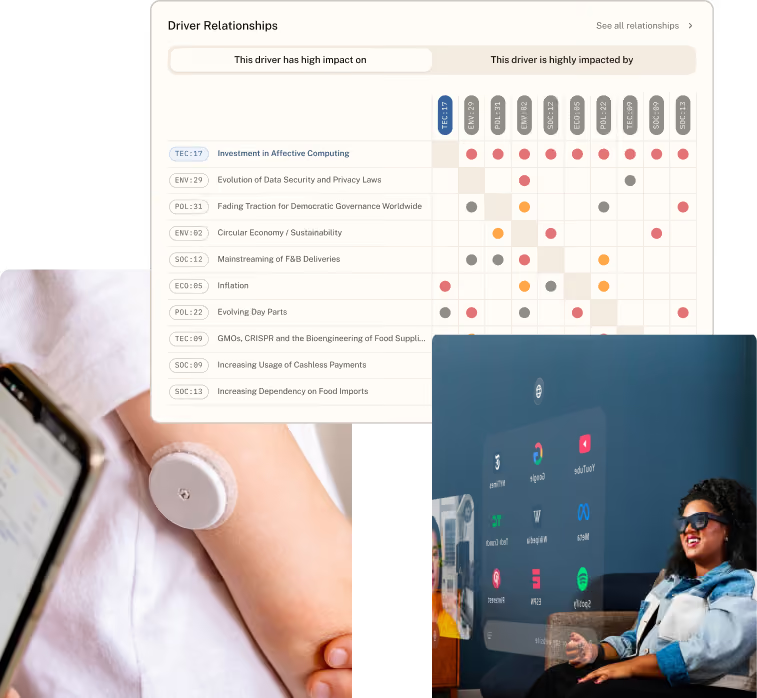
Ten drivers sit behind this force. Three carry movement figures today; interest in longevity lifestyles, holistic wellbeing, next-generation health trackers, obesity rate, non-communicable diseases and the two government intervention drivers are tracked qualitatively.