Register interest
Which topic are you interested in?
Sorry, something went wrong. Please try again or email us directly at hello@synthesis.partners if this persists
We've added you to the list. In the meantime, can we help with anything else?
Thanks, we'll be in touch soon.
Sorry, something went wrong. Please try again or email us directly at hello@synthesis.partners if this persists
Menu 2037

Access: There are two likely outcomes for good nutrition

Who gets good nutrition, and who doesn't? The environments and systems shaping what is available, affordable, and reachable. And where those systems are widening, narrowing, or breaking down.

Raising the ceiling

The median consumer was always a poor proxy for anyone. By 2037, the food industry has stopped designing for the average and started designing for you. Your biology, your life stage, your deficiencies. The goal is no longer adequacy. It's the maximum possible nutrition, and the ceiling keeps moving upwards.

Likelihood
58.3%

Key drivers

Uncertainty
High
Medium
Low

Insights powered by Synthesis Schema.

Precision Fermentation Technology

64.6% since 2016

Artificial Intelligence

21.8% since 2016

Personalised Medicine and Nutrition

20.5% since 2016

Autonomous last-mile delivery

14.9% since 2016

Ageing Population

2.3% since 2016

Interest in Longevity Lifestyles

1.6% since 2016

Consumer Health Consciousness

-0.2% since 2016

Within-Country Economic Inequality

-0.5% since 2016

Extreme Weather Events

-12.8% since 2016

Overview

What is driving it

Three change forces drive this scenario.

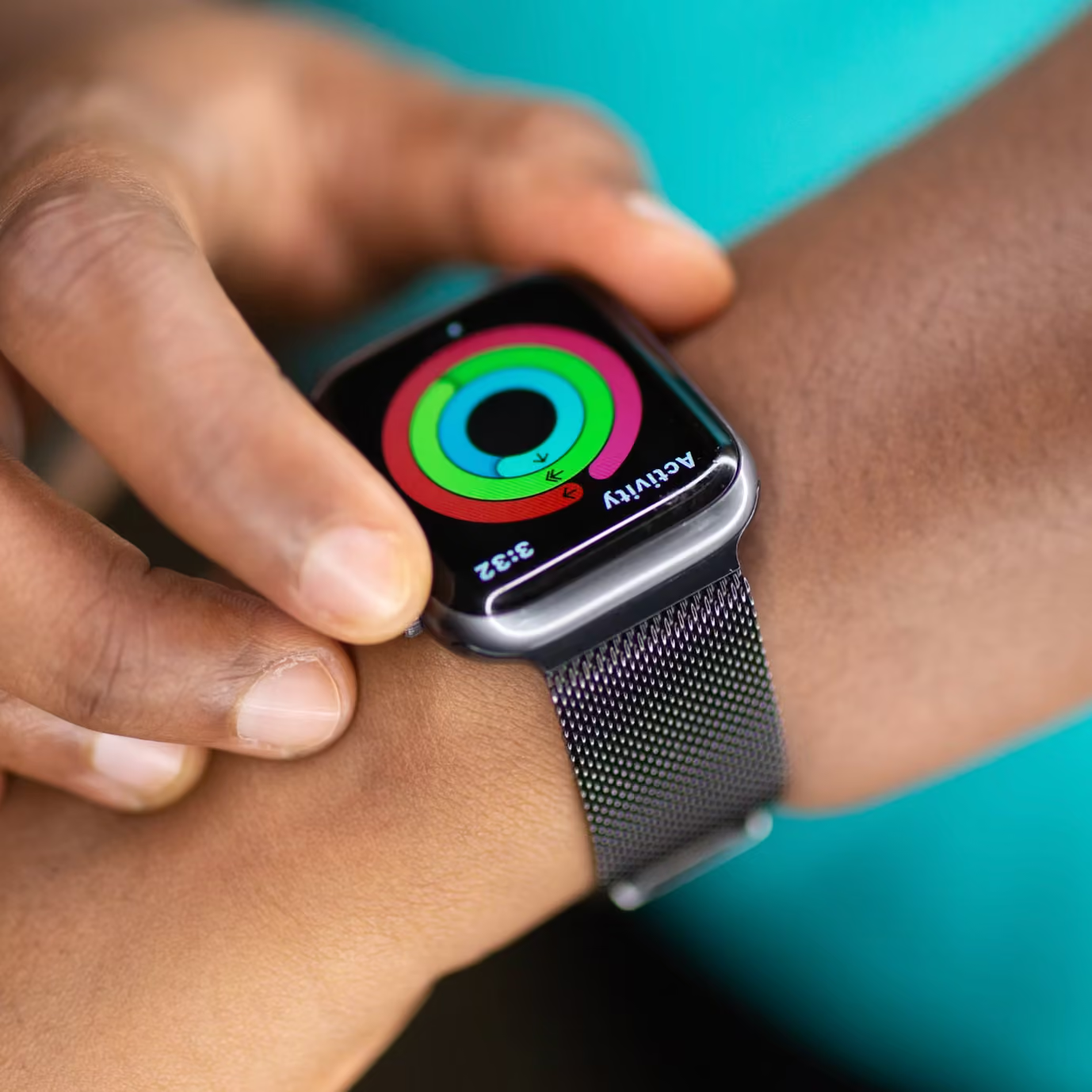
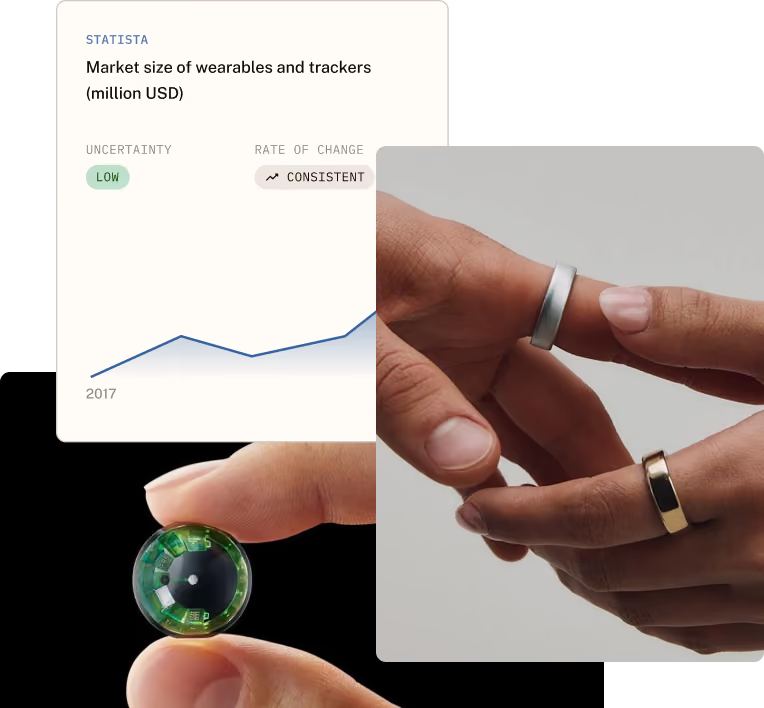
Nutrition as advantage. Nutrition becomes a competitive edge, and capital follows. Wearables feed biological data into platforms offering custom meals, tailored supplements and real time dietary adjustments.

Biological fluency. Everyday foods are redesigned for specific biological outcomes like focus, recovery and metabolic support. The real barrier is not cost, it is knowing how to read your own biomarkers and act on them.

The wellness clubhouse. High end social and fitness clubs embed expert grade nutrition into daily life, making professional dietary guidance a natural feature of the spaces where affluent consumers already spend time.

From today to 2037

Today, one-size-fits-all is the norm. Consumers buy a generic multivitamin from a pharmacy and hope it fills the gaps their body actually needs, with no real data to back it up. By 2037 these become bio-synced pods: a 3D printer in the kitchen syncs with health wearables to produce a single custom nutrient pod each morning, calibrated to that day's exact needs.

Today, fixed eating windows govern the day. Breakfast, lunch and dinner arrive at set times while people guess their way through the gaps, grabbing coffee to push through the afternoon slump, never truly in sync with their body's rhythms. By 2037 people are fed by data, not habit. AI models continuously learn each person's metabolic rhythms, sleep quality and energy patterns, then recommend exactly what to eat and when, fuelling the body before the slump arrives.

What changes across the value chain

Every stage is rewritten by: how high can the ceiling go, and who can prove they reached it?

In sourcing, today's agricultural systems prioritise yield over nutrient density, so the same crop varies wildly in vitamin and mineral content depending on where and how it is grown. What if companies sourced exclusively from regenerative estates, where soil and sea ecosystems are actively enhanced so every ingredient is harvested at its highest biological potential?

In packaging, high end nutrients are delicate and break down quickly, so standard plastic or glass is not enough. What if we used edible nanopackaging technologies that help food retain peak nutrient levels for longer?

In processing, microplastic contamination of soil is now detectable in the human bloodstream. What if GMO crops were engineered to block microplastics at the cellular level, guaranteeing a pure grade base that only the most advanced producers can deliver?

In distribution, as premium nutrition becomes more personalised, consumers expect it to come to them. What if autonomous delivery systems brought custom nutrition directly to the door, synced to health data and restocked before you notice you have run out?

In brand communications, the more personalised nutrition becomes, the harder it is to know what you qualify for. What if brands replaced generic health campaigns with personalised access programmes, matching consumers to the exact products their biology calls for?

The counter-scenario

This is one of two plausible outcomes for good nutrition. Its opposite, Raising the Floor, zooms into markets making affordable and convenient food meet minimum standards of nutrition for the masses. The two are not mutually exclusive, and the commercial risk sits in planning as though only one will arrive.

What comes next

Access is one of four field notes in Menu 2037. Agency follows, asking who controls what you eat and which brands still have a seat at that table. Wearables track intake, AI recommends meals, and smart fridges reorder automatically. As choice becomes increasingly guided and outsourced, expect profound change for food businesses, channel strategy and consumer trust.

‍

Key implications

Personalisation is more platform play, than product play

Businesses that treat personalisation as a standalone feature will plateau. Those that build or plug into closed-loop systems, wearables, and health platforms will own the relationship. Cohort-level personalisation is a scalable entry point into that ecosystem.

Function alone won't hold consumer attention: the ceiling demands variety and experience

A product that is optimised but joyless will not hold. The aspirational nutrition of 2037 is not a single hero ingredient or a perfect meal plan. It is radical diversity: 30 to 40 different plants a week, every meal different in ingredients and cooking style, and all of it something people actually look forward to. Businesses competing at the top need to think in terms of breadth, culture, and pleasure alongside biological performance.

Absorption is the next frontier in nutritional access

Nutrient content is the starting point. What separates products at the top is how effectively the body absorbs what they put in, and whether food works with the body's own signals. A largely unoccupied space, with the opportunity still under-exploited, especially for ageing and underserved populations.

Raising the floor

We are eating more and getting less. By 2037, states have stopped treating that as a consumer problem. Minimum viable nutrition is infrastructure, funded, standardized, and built into the food system the way clean water is. The nutritional floor has risen. Not through choice, but by design.

Likelihood
41.7%

Key drivers

Uncertainty
High
Medium
Low

Insights powered by Synthesis Schema.

Nutritional Literacy

22.2% since 2016

Artificial Intelligence

18.5% since 2016

Interest in Food Valourisation

16.0% since 2016

Government Intervention on High Fat Salt and Sugar (HFSS) product

12.6% since 2016

Food Insecurity and Undernourishment

3.0% since 2016

Ageing Population

2.3% since 2016

Non-Communicable Diseases (NCDs)

2.2% since 2016

Within-Country Economic Inequality

-0.5% since 2016

Consumer Health Consciousness

-0.2% since 2016

Overview

The shift

We are eating more and getting less. By 2037, states have stopped treating that as a consumer problem. Minimum viable nutrition has become infrastructure: funded, standardised, and built into the food system the way clean water is. The nutritional floor has risen, not through consumer choice, but by design.

What is driving it

Three change forces drive this scenario.

Nutrition as public infrastructure. A sick population is an economic burden. States and institutions treat healthy nutrition as a civic utility, funded, standardised, and built into the food system the way clean water and sanitation already are.

Democratised nutritional literacy. Universal, standardised health symbols create a common understanding of nutrition, so diverse populations can make informed basic food decisions regardless of income or background.

Healthy by design. The healthiest choice becomes the easiest one. Nutrition is shaped by proximity: which products sit at eye level, which stores are close by. When the healthiest option is the most visible, it becomes the default.

From today to 2037

Today, staples stripped of nutrition rule. Affordable basics like white bread, rice and noodles dominate diets but are highly processed and nutrient poor, and the resulting long term health issues fall hardest on lower income populations. By 2037 these become mandated multi-nutrient staples: basic loaves legally required to meet a baseline standard of specific fibres, raising the nutritional floor in the cheapest staples.

Today, food deserts persists. Residents in low income areas rely on convenience stores for high sugar snacks because fresh produce is either too expensive or too far away. By 2037 that becomes the automated fresh-lock, with AI managed vending machines in every apartment block providing 24/7 access to low cost, fresh meals fully utilising nutritional surplus like fruit juicing pulp or brewer's spent grains.

What changes across the value chain

Every stage is rewritten by the question: how do you raise the nutritional baseline and make it cheap enough to be universal?

In sourcing, climate is disrupting dominant agricultural practices and making popular staples more expensive and volatile. What if we sourced exclusively from resilient staples like sorghum or hardy tubers, crops that grow in poor soil with almost no water and are also nutrient dense?

In packaging, poor packaging, storage and transport waste food long before it reaches the grocery shelf, and after it leaves. What if improved packaging technologies and AI stock monitoring extended the life of basic foods, so waste costs fall?

In distribution, large grocery stores are often too far away or carry too little variety for those with the least resources. What if automated vending machines and stores improved access to a wider range of fresh foods at community sites like apartments and bus stops?

In brand communications, government regulation clamps down on temptation and desire marketing for unhealthy food. What if brands replaced traditional advertising with real time availability maps, showing exactly where the nearest fresh batch is stocked and how many portions remain for that neighbourhood?

The counter-scenario

This is one of two plausible outcomes for good nutrition. Its opposite, Raising the Ceiling, zooms into markets raising the bar for optimisation through personalised solutions and precision science, tailored to individual biology and goals. The two are not mutually exclusive, and the commercial risk sits in planning as though only one will arrive.

What comes next

Access is one of four pillars in Menu 2037. Agency follows, asking who controls what you eat and which brands still have a seat at that table. Wearables track intake, AI recommends meals, and smart fridges reorder automatically. As choice becomes increasingly guided and outsourced, expect profound change for food businesses, channel strategy and consumer trust.

Key implications

Language and design include or exclude as much as price and channel

If consumers cannot understand what makes a product better, the nutritional investment is invisible. Simplify deliberately, and refuse to use design that shuts people out.

Accessibility starts upstream

How we farm, source, treat the soil, the farmer, and the waste stream. Spent grains, indigenous crops, regional side streams: the nutritional raw material already exists and is largely going to waste. Businesses that build supply chains around these inputs unlock cost advantages, sustainability credentials, and category differentiation simultaneously.

Embed better nutrition into what people already use

Behaviour change at scale is slow and expensive. The faster route is embedding better nutrition into products, formats, and environments people already use. For food businesses, this means treating reformulation and default-setting as a growth strategy, not a regulatory checkbox.

Try Synthesis Schema

Get a demo of Synthesis Schema to see what it can unlock for your team.

Book a demo