Register interest
Which topic are you interested in?
Sorry, something went wrong. Please try again or email us directly at hello@synthesis.partners if this persists
We've added you to the list. In the meantime, can we help with anything else?
Thanks, we'll be in touch soon.
Sorry, something went wrong. Please try again or email us directly at hello@synthesis.partners if this persists
Menu 2037

Absorption: There are two likely outcomes for nutritional trust

What did it actually do for you? The shift from inputs to outcomes. From industry optimised for purchase, to what happened in the body and how people feel the next day. How effectiveness is measured, validated, and questioned in a world where more is tracked and the gut-brain connection is clearer.

Trust in precision

By 2037, trust is something you can measure. Absorption is no longer inferred from a label but proven: nutrients engineered to work with the body's entire ecosystem, dosed to the individual, and verified molecule by molecule from farm to fork. What the body actually took up has become a number, and the brands that can produce that number own the claim.

Likelihood
55.7%

Key drivers

Uncertainty
High
Medium
Low

Insights powered by Synthesis Schema.

Precision Fermentation Technology

64.6% since 2016

Interest in Microplastic Effects on Health

46.2% since 2016

Artificial Intelligence

21.8% since 2016

Personalised Medicine and Nutrition

20.5% since 2016

Food Traceability and Blockchain in Supply Chains

13.7% since 2016

Convergence of Pharma and Nutrition

8.8% since 2016

Novel Foods

6.1% since 2016

Nutrient Bioavailability

4.1% since 2016

Urbanisation

0.6% since 2016

Overview

What is driving it

Three change forces drive this scenario.

Novel foods and processing. Advances in novel foods and precision fermentation techniques keep pushing the frontier of what is possible in precision.

Radical food traceability. Increasing demand for absolute certainty in nutrient claims is driving the adoption of blockchain technology to verify the exact molecular journey of food.

Personalised health focus. Growing health consciousness is driving a shift towards highly personalised, targeted solutions and optimised nutrition.

From today to 2037

Today, isolated nutrient fixes are the default. Health is managed by treating the body as separate parts, using isolated supplements to patch specific nutritional gaps without considering overall absorption. By 2037 this becomes a whole-body nutrient system, where nutrients are precisely engineered to work with the body's entire ecosystem, specifically targeting the gut microbiome for optimal, scientifically measured absorption.

Today, consumers settle for claim reassurance, seeking comfort in nutritional claims and relying on labels and measurable proof of health benefits. By 2037 they demand scientific reassurance: real proven science and measurement that provides the ultimate reassurance of nutritional value.

What changes across the value chain

Every stage is rewritten by: can you prove what the body actually absorbed?

In sourcing, supply relies on mass production methods rather than precise nutritional profiling, leading to variable nutrient levels. What if we sourced ingredients using novel extraction processes to ensure exact, individualised nutrient levels and maximum bioavailability for optimal absorption?

In formulation, products are generally one-size-fits-all, not tailored for individual metabolic needs or maximum nutrient uptake. What if we formulated products so dosage could be tailored to specific metabolic needs and engineered them for maximum uptake?

In processing, methods focus on shelf life over precise nutrient control, often degrading bioavailability. What if we used advanced processing techniques to precisely control and tailor the release of nutrients, increasing the bioavailability of every one?

In packaging, materials passively contain products without monitoring or actively maintaining nutritional integrity. What if we used smart packaging that actively monitors and maintains the precise nutritional integrity of the product right up to consumption?

The counter-scenario

This is one of two plausible outcomes for nutritional trust, and the likelier of the pair. Its opposite, Trust in Abundance, places faith in the system rather than the study: restored soil, diverse harvests and traditional processing, read intuitively through provenance and the health of the living chain. The two are not mutually exclusive, and the commercial risk sits in planning as though only one will arrive.

What comes next

Absorption is one of four field notes in Menu 2037. Agency follows, asking who controls what you eat and which brands still have a seat at that table. Wearables track intake, AI recommends meals, and smart fridges reorder automatically. As choice becomes increasingly guided and outsourced, expect profound change for food businesses, channel strategy and consumer trust.

Key implications

Precision Formulation

Formulate products with engineered nutrients designed to work with the body's entire ecosystem for optimal absorption.

Verified Scientific Links

Implement processing methods backed by real, proven science and measurement to provide ultimate reassurance of nutritional value that consumers can scan.

Engineered Nutrient Release

Develop precision dosage-based meals that deliver exact nutrient profiles tailored to individual physiological needs and optimal absorption.

Trust in abundance

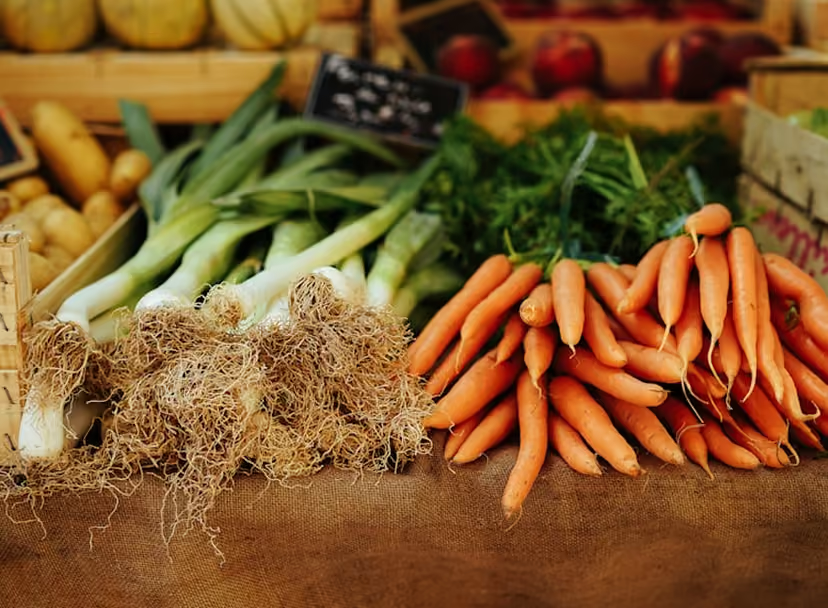
By 2037, trust is placed in principles over precision. Absorption follows from restored soil, diverse harvests and traditional processing: eat the rainbow, and the bioavailability takes care of itself. Nutritional quality is read intuitively, through provenance, plurality and the health of the living chain, rather than through a panel of measured claims. No one weighs out kimchi or sauerkraut.

Likelihood
44.3%

Key drivers

Uncertainty
High
Medium
Low

Insights powered by Synthesis Schema.

Investment in Regenerative Business

87.4% since 2016

Interest in Microplastic Effects on Health

46.2% since 2016

Culinary Diversification

19.9% since 2016

Food Sovereignty

16.7% since 2016

Interest in Food Valourisation

16.0% since 2016

Climate Displacement

13.4% since 2016

Reformulation Backlash & Ingredient Scrutiny

11.3% since 2016

Nutrient Bioavailability

4.1% since 2016

Phytonutrient Diversity & the Rainbow Diet

0.9% since 2016

Overview

What is driving it

Three change forces drive this scenario.

Regional trade fragmentation. Supply chains and trade agreements fragment as most countries opt for regional agreements.

Ecosystem and soil reset. Growing understanding of, and desire to reset, ecosystems and topsoil, focusing on the soil microbiome and living soil.

Rise of regenerative activism. Consumers activate around regeneration and green initiatives to an extent not seen before.

From today to 2037

Today, food production operates as a set of fragmented systems, prioritising increased monocrop yields over the holistic health of the living environment. By 2037 the focus shifts to restored systems, where the effort goes into regenerating entire ecologies, trusting that healthy soil and a healthy living chain will naturally yield diverse goodness.

Today, consumers rely on outsourced trust, handing it to familiar mass-market brands and to convenience, disconnected from the origin of their food and the systems that produced it. By 2037 that becomes intuitive trust: consumers demand complete transparency and connect directly with regenerative origins and the natural abundance of the environment.

What changes across the value chain

Every stage is rewritten by: is the living system healthy enough to do the work for you?

In sourcing, supply relies on conventional agriculture that often depletes soil, yielding crops with lower nutrient density. What if we sourced from highly regenerative systems producing an abundance of nutrient dense, easily absorbed crops and animal products? What if we had consistent systems to measure the nutritional uplift?

In formulation, products often rely on isolated, synthetic nutrients rather than the natural synergies found in diverse whole foods. What if we formulated with a diverse abundance of whole foods, relying on those natural synergies to maximise nutritional benefit?

In processing, industrial methods often strip away natural nutrients rather than multiplying bioavailability. What if we adopted traditional, minimal processing methods like fermentation, which naturally multiply the bioavailability of abundant harvests?

In packaging, materials often rely on synthetic preservatives to protect nutrients, lacking sustainable ways to preserve abundance naturally. What if we used sustainable packaging that protects abundant nutrients without synthetic preservatives?

The counter-scenario

This is one of two plausible outcomes for nutritional trust. Its opposite, Trust in Precision, treats trust as something you can measure, proven molecule by molecule from farm to fork. The two are not mutually exclusive, and the commercial risk sits in planning as though only one will arrive.

What comes next

Absorption is one of four field notes in Menu 2037. Agency follows, asking who controls what you eat and which brands still have a seat at that table. Wearables track intake, AI recommends meals, and smart fridges reorder automatically. As choice becomes increasingly guided and outsourced, expect profound change for food businesses, channel strategy and consumer trust.

Key implications

Regenerative Sourcing

Source ingredients from restored ecological systems, prioritising soil health and diverse goodness.

Ecological Synergy

Connect directly with regenerative origins to build intuitive trust and complete transparency with consumers.

Abundant Ingredient List

Employ technology in service of nature during processing to enhance, rather than replace, the natural abundance of the environment.

Try Synthesis Schema

Get a demo of Synthesis Schema to see what it can unlock for your team.

Book a demo