Over 40% of the world's daily calories come from white rice, noodles, and bread. Foods that are affordable and familiar, but increasingly stripped of nutritional value during processing. As health journalist Julia Belluz and metabolic scientist Kevin Hall argue in Food Intelligence, the way most people eat is “less a failure of willpower than the predictable result of a distorted food environment”.
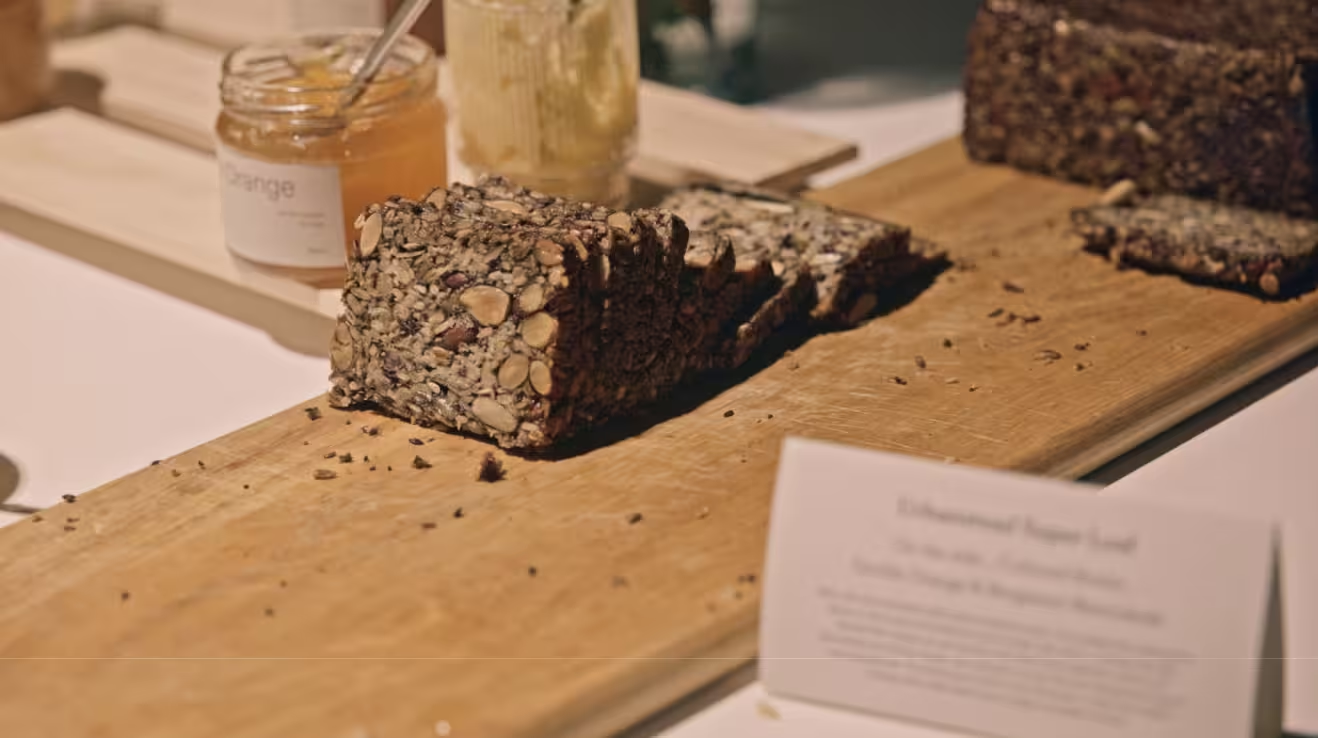
At our Access Test Kitchens, we swapped regular white noodles with ProTEGO noodles, plant-based, protein- and fibre-rich dried noodles made from the byproduct of processing peanuts and sweet potatoes, and transformed a cup noodle entrée into something nutritionally dense: 32g of protein per 100g, low GI and high fibre, keeping people fuller for longer. Out of 100 diners, only three asked if the noodles were different. With over 337 million cup noodles consumed daily, what if we changed the staple to raise the floor?
2. Smaller Is Mightier
More than 3 billion people depend on the ocean for protein, yet over 30% of commercial fish stocks are harvested at unsustainable levels, with vulnerable coastal communities bearing the greatest burden.
At our Access Test Kitchens, working with BlueYou's Selva Shrimp programme in Southeast Asia, we explored a pattern that holds across ocean and land alike: the conditions in which animals are raised directly shape the nutritional value of what ends up on our plates. Smaller species like shellfish, sardines, and shrimp are often more nutrient-dense, lower in mercury, and less extractive than the large species we default to. Just as degraded soil produces less nutritious crops, degraded ecosystems produce less nutritious protein.
We also served BlueYou's arapaima, a large freshwater fish farmed in the Amazon. It is an amazing sustainability story, but a less perfect fit for nutrition, as one guest pointed out. If we’re looking for greater nutritional density, smaller fish offer the biggest opportunity.
3. Nutrition’s Longevity Moment
In the UK, healthy life expectancy (HALE) has fallen sharply by two years over the past decade, to 60.7 years for men and 60.9 for women. People are living roughly as long, but spending more of that time in poor health. The gap between rich and poor areas is now over 20 years of healthy life. In the US, the trajectory is similar: forecast to drop from 80th to 108th in global HALE rankings by 2050. Medical advances have driven down mortality from heart disease, cancer, and stroke for three decades. But diet has now overtaken tobacco as the leading risk factor for death, and those gains are being steadily undermined by what people are eating.
At our Access Test Kitchens, longevity was the top-ranked health goal among 100 guests. People are already thinking about what they eat today as an investment in how they age well tomorrow. The pattern is similar to skincare: what began as a corrective category became a preventive one, increasingly functional and personalised.
When designing the second course, we worked with Bricolage to create a koji-inoculated pearl barley, broccoli and almond dukkah, using koji fermentation specifically to unlock ergothioneine, a compound the body cannot produce on its own and whose depletion is linked to frailty and cognitive decline. It is one of the few practical ways to deliver this compound through food.
“We're moving towards a world of more personalized nutrition that's going to help people from a health front,” says Dr Naras Lapsys, Chief Clinical Officer at Chi Longevity. "At the moment, it's a very costly process. I'd like to see precision nutrition becoming far less expensive over time." Scientific evidence continues to improve. The opportunity lies in making it available at a price point where it can raise the floor, not just extend the ceiling.
4. A Nudge Is Enough
Behavioural economists have long understood that small changes to how and where food is presented have a big impact on what people choose. Regulation is catching up: South Korea was the first country to require cancer warnings on alcohol packaging, and from 2028 Ireland mandates that all bottles carry "There is a direct link between alcohol and fatal cancers" in red capital letters. At our Access Test Kitchens, we put this to the test, adding warning labels to sugary desserts and alcohol, and moving the less healthy options out of view and to the back page of the menu.
Quite how big the change surprised us and will catch the industry if not prepared early. Given the choice between an Opera Gâteau and a chia kiwi seed pudding, 3 in 4 guests chose the kiwi. For drinks, over 80% chose a TCM-inspired 0.0 Amaro over complimentary wine or digestifs. A label and a menu reorder, applied to 100 guests, shifted the majority of choices in the room.
5. Real nutrition is more than macro-maxxing
First, we put protein in everything. Fibre is the next candidate. But are we still missing something?
Guests at the Access Test Kitchens designed their own cup noodle, choosing broths, proteins, and add-ons. But picking turmeric broth without the black pepper add-on meant missing out: piperine, the active compound in black pepper, can increase curcumin absorption by up to 20x. Similarly, the chia kiwi seed pudding from our dessert course delivered folate in a form the body can actually use, because unlike leafy greens, where folate is easily destroyed by cooking, kiwi is eaten raw. The scoring sparked deeper conversations about the complex interactions between ingredients and what the body can absorb. Nutrition is what the body can actually use.
Brands like Zespri are already thinking this way. Their Grown for Good platform is built on the belief that the world is overfed yet undernourished. Rather than focusing on singular macros, the platform puts micronutrient density and nutrition literacy at the centre of everything they produce.
It's a conversation we're just getting started on. Our Absorption Test Kitchen lands in Melbourne on 3 September.
Explore our Futures platform
We collect all of these signals, plus hundreds of others, in our Synthesis Futures platform.
Thanks, we'll be in touch soon to give you access to the platform.
Sorry, something went wrong. Please try again or email us directly at hello@synthesis.partners if this persists